

the algorithm is not your ex
or: why trying to game or understand it is a losing battle and you've got bigger fish to fry

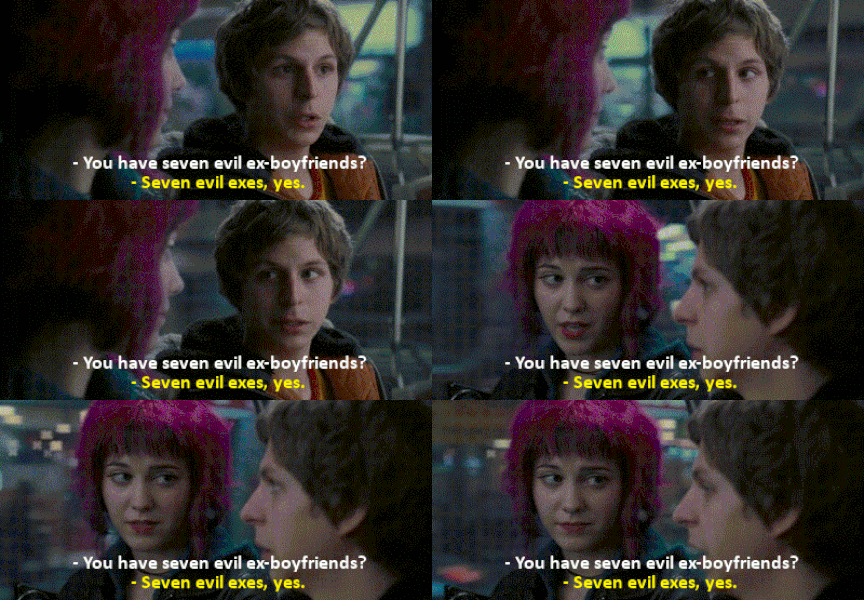
It has been a hot minute since I’ve been on the dating scene, but I know a thing or two about a thing or two1. Like we’ve ALL been hung up on that one ex, thinking about them and wondering if they’re thinking about us. And then seeing them post something where they are having fun like don’t they even CARE about you, don’t they miss you, why are they doing this TO YOU!? And then like years later you’re looking back on it and you’re thinking, “man, I really overreacted on that one…this person probably was hurting and it wasn’t all about me. good riddance!”
Anyway, back to social media…say you post a reel, then you go about your day convincing yourself that you don’t even care what the engagement is like, you make it seven minutes before you open the app “just to check something” and then…oops…you’re on your reel insights page2. And the views are... fine? I guess? I mean, they could be 0, so anything above that is ok, right? And yet somewhere in your brain a tiny voice goes: “it’s over. The algorithm hates me. I peaked in March. I will never see good engagement again, so what’s the point!”
Good news/bad news - the algorithm is not your ex. It is not sitting somewhere thinking about you, judging you, and then deciding you’re not worth its time. It did not see your post and choose violence by not showing it to everyone and their cousin. It is a giant, indifferent sorting machine3, and the sooner you stop taking its behavior personally, the sooner you can start using your data like the marketing professional you are slowly (reluctantly?) becoming.4
point 1: the numbers you’re crying over don’t matter
For someone who preaches the benefit of “LOOK AT THE DATA”, that sure did come out of left-field, didn’t it? In fact, I stand by it because often the metrics that feel the biggest are the ones that matter the least.
Views are a vanity handshake. Likes are a polite nod from a stranger on the subway5. Follower count is a number that has made exactly zero people buy a book on its own6. These are the metrics the apps show you FIRST and LOUDEST because they’re designed to keep you posting or trying to figure out how to win at posting, not to help you sell novels. It’s like playing slots in a casino - a losing game but you’re always thinking maybe this time will be when my luck turns around7.
None of the numbers you’re looking at means your content is bad (or, conversely, good for the long term). It means you’re grading yourself on the wrong rubric and forgetting about the fact that even getting into a good school requires more than just good grades - you need to be well-rounded, you need letters of recommendation, you need extracurriculars and volunteering and probably a business you sold to a multinational corporation8.
point 2: there are four numbers that can actually help you predict whether or not your book will sell
Will looking at these guarantee that you’re going to become a NYT #1 Bestselling author tomorrow or that you will sell 1,000,000 copies of your book? No. Because anyone that guarantees that is both lying to you and delusional. But they can be a good indicator that you are doing something that is resonating with the right readers.9
Saves: A save means “I want to remember this book exists.” That is buyer behavior, not just a casual scroller. Someone saving your trope graphic or your blurb post is bookmarking you for when they are ready to engage with what you’re selling. The behaviour has shifted away from just LIKES to LIKES + REPOSTS, so now more than ever, if someone is saving your post there is a reason behind it. It’s likely the third thing they are doing now when engaging. Your save ratio is one you should always look at.
Shares/sends: That little paper-plane icon is gold when it comes to really seeing how your content is landing. When someone DMs your post to a friend or adding it to a story, they are doing your marketing FOR you, for free, with a personal endorsement attached. PLUS, this is a huge signal to Instagram that “this content is good, people are sharing it, we should show this content to even MORE people.” This is the single most valuable thing that can happen to a post - it’s intimate, meaningful, and is worth its weight in empty likes.
Link clicks: Preorder link, newsletter signup, Goodreads page - whatever you’re pointing at. This is the moment someone stops scrolling and takes action. If your reach went down but your link clicks went up? That was a GOOD month. You should be proud!
Email signups: Every email you capture is a reader no algorithm can take from you. It’s the relationship that goes beyond socials, and becomes something more meaningful that you can grown and nurture like a love fern.
This is the metric with the longest shelf life, because it compounds like if you’d invested in Apple stock in 2001.10
What you’ll notice with these metric is that they all measure intent, not attention. Lots of views or likes is like a popularity contest in high school, in that is means literally nothing. Remember that attention is rented - it’s temporary - and intent converts.
point 3: let me introduce you to the 20-minute monthly ritual
You do not need to become a data person, but I won’t stop you if that’s what you really want to be. All you need is twenty minutes monthly, a good podcast or audiobook or playlist, and the drink/snack combo of your choice.
If you need song inspo, may I suggest this evergreen banger that’ll make you dance in your seat and say bye bye to your ex:
With that 20 minutes, here’s your new ritual -
Minutes 1-10: Open your insights on Instagram. Pull your top 5 posts by saves and shares (not views, never views, ignore views, look away from views). Now write down what they have in common - are they all trope-forward or a character quote or do they all show your face11 or is there a hook in the first line? Play your own game of “spot the similarities” across the post itself, and secondarily the caption.
Minutes 10–15: Check your link clicks and email signups for the month, across all your posts. Are they up, down, or flat versus last month? Give yourself a little red/yellow/green sticker if you’re a visual learner like me. A green is GREAT, a yellow is fine, a red one is something you need to (calmly, kindly to yourself, objectively) dig a bit into. And remember that one month doth not a pattern make, m’lady.12 Look for trends over 2-3 months, instead. Time of year, social noise, server outages, international sporting events…it can all impact one single month.
Minutes 15–20: Pick ONE thing to do more of next month based on what you found, and ONE thing to quietly stop doing. This can be recreating posts like the ones that really did numbers for you, or leaning heavier into a CTA that drives email signups, or knowing that you’re about to go on a preorder campaign for your next book getting readers to add to Goodreads. Either way ONE thing to start, ONE thing to stop - c’est tout. Now close the tab and go enjoy the heatwave13.
That’s it. No spreadsheet with fourteen tabs, no pivot tables, no entry level data analytics required. No 6am posting-time astrology, no “what if I just…?”, no more guessing. Simply: what drove intent = do more of that.
Pro Level Tip: keep a pinned running note on your phone called “LOOK AT ME GO.”14 Every time a post over-performs on saves or sends, drop the link in there. In three months you’ll have a personal playbook of what YOUR audience responds to which is worth WAY more than any generic best-practices article (yes, including this one - I know my place).
and just like that, the breakup is complete.
The next time a post “flops,” I want you to ask yourself one question before you spiral: did it flop on views, or did it flop on intent? A quiet post that captured three emails and eleven saves didn’t flop. It worked, actually. Really well. It just didn’t perform for the room like a Southern debutant.
The algorithm isn’t your ex. It’s your weird (not in a creepy way) landlord. You don’t need it to love you or even be your friend - you just need to know the rules of the building while you quietly buy your own house next door.15
Data, baby!
xo
Ada
I know a few things about a couple of things
Funny how you just sort of black out and always end up there somehow?
In fact, by calling it “THE ALGORITHM” it gives it way more power than it’s worth. Like those toy aliens in Toy Story obsessed with “THE CLAW”
You will love marketing by the time I’m through with you, dammit!
Maybe with an uncomfortable amount of eye-contact, depending on who the like is from
And yes, I can hear you yelling “BUT PUBLISHERS CARE ABOUT IT, ADA!”…don’t worry, we will get to that in an upcoming newsletter. Because…yes and…
Basically, social media is like having a gambling addiction sometimes and I’m not exaggerating when I say that…same brain chemistry
I don’t know anymore - when I went to school, I needed to write an essay and pass a test but some of the resumes from new grads I’m seeing these days have me thinking I’m not doing enough with my life NOW, let alone then. RIP Ada who used to go to class, work part-time, and party Thursday-Sunday nights.
The marketing saying you always need to remember is: Right MESSAGE, for the right CUSTOMER, at the right TIME
I did not, in case anyone was wondering.
A thing every author loves, truly
Or whatever Shakespeare said
I am writing this as the heatwave starts, and I hope it’s over by the time this is posted. We are, literally, cooked.
Or “Receipts” or “Insta Data” or “I’m only doing this because Ada told me to”…name it anything, is what I’m saying
Your newsletter is your house. I cannot stress enough the importance of newsletters. Newsletter!
subject line? perfect. content? incredible. thank youuu!
Excellent advice, as always! Adding a folder to my Notes app titled: DO WHAT ADA SAYS